top of page
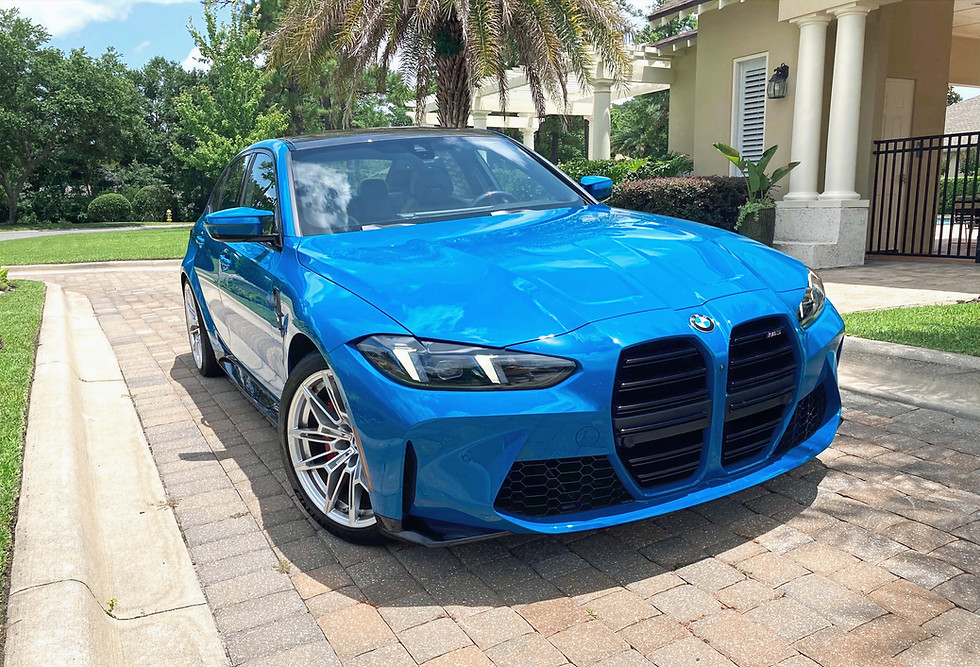
BMW M3_edited_edited.jpg

BMW’s Classic Sports Sedan.

The Bavarian Motor Works products are still defined by the automotive enthusiast marketplace as purveyors of The Ultimate Driving Machine, an ad slogan that’s stood the test of time. BMW’s M3 sedan carries that tradition forward in 2025 with respectable credentials with its smooth inline six making 473-horsepower connected to an available six-speed manual gearbox. That’s more power than fourth-generation M3 with a 4.0-liter V8 that was offered back in 2007 to 2013, although I did love that 8-cylinder grumble and 8,300 RPM redline.

Today’s M3 models are offered in three trim levels; a well-equipped Standard, a 500 HP Competition and a Competition with all-wheel-drive with starting prices ranging from $76,000 to $85,300. Options add up quickly. Our final MSRP was $92,225 with the most expensive $4,500 option simply ordering Laguna Seca Blue paint. I’d settle for Portinao Blue Metallic at no added cost but they didn’t consult me.

An interesting option is the $2,500 M Driver’s Package, an added attraction that allows the car to attain 180 MPH instead of that snail-like 155. It comes with driver training at one of BMW’s racetrack-based schools, a rather handy feature if you wish to transport yourself at eye-watering haste. I’d recommend the Shuttle Landing Facility down in Cape Canaveral to check out the 180 number. Fresh tires is a wise addition as well.

I didn’t verify the top speed since an orange jump suit isn’t my fashion choice, but leaning into the throttle verifies that there’s plenty of power available in every gear. And while self-shifting isn’t as quick as paddles, the connectivity of man and machine is a special joy for enthusiasts who still want to fully participate. It’s not as if we’re going to meddle much under the hood anymore.

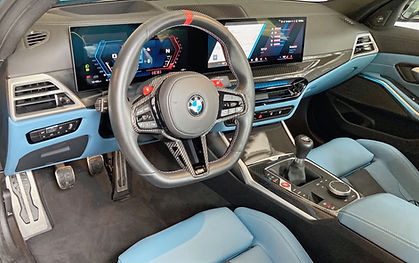
Inside, BMW has modernized the cockpit with a sweeping digital panel that displays a configurable instrument layout straight ahead with the now ubiquitous infotainment off to the right. The leather seats are snug with tall bolsters and the steering wheel has great thumb grips at 9 and 3 with a proper squared-off bottom. And the wheel’s 12 o-clock has a bright red trim to make sure you’re pointed straight after exiting that turn in a drift. Additionally, two “M” levers are available to choose track or play time. In Italy they simply call that style of driving recess.

In such a performance-oriented machine with tight suspension, occupants might expect a bit less road comfort. The M3 is firm but not the least bit harsh and that firmness translates into razor sharp reflexes, an attribute you’ll like a lot when you encounter unexpected drama out in the motoring wild.

BMW offers quite a wide variety of nice handling cars and SUVs and the 3-series sedan has model options beginning at a relatively modest $47,125. But the Motorsport “M” cars are quite special with performance and appearance that commands a princely sum. And of course there are competent rivals. If you wish to stay in German territory, Audi’s RS 5 has specs that match up and the Mercedes AMG C 63 SE claims 671 HP from a turbo four-cylinder engine combined with an electric motor. But if you wish to do your own shifting, Cadillac’s CT4 V Blackwing is a compelling alternative.
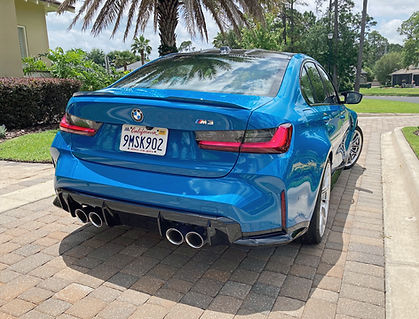
BMW M3 Rear_edited.jpg
BMW M3 Interior_edited.jpg

THE FINE PRINT

2025 BMW M3 Sedan

TYPE:  Front-engine, rear-wheel-drive

ENGINE:  3.0-liter I-6

HORSEPOWER:  473 @ 6,250 RPM

TORQUE:  406 lb.ft. @ 2,650 - 6,130 RPM

BASE PRICE: $76,000

AS TESTED:  $92,225

FUEL CONSUMPTION:  16-city, 23-highway, 19-combined

For some of us who’ve been around the automotive industry for more than a handful of decades, the term “muscle car” was popularized in the 1960s era of American automakers stuffing big V8 engines into coupes, sedans and a few convertibles. Fast forward to today’s market and, at least for the moment, the only former “Big Three” automaker stuffing snorting V8 engines into passenger cars is Ford. But this hardly means that petrol powered bragging rights are the sole province of the fellas in Dearborn, Michigan.

First a short history lesson. The Dodge brothers built their first car in 1914 and in 1928 their company was acquired by Chrysler. In 1998 the iconic American automaker joined Mercedes-Benz parent to create DaimlerChrysler Motors, an alleged “Merger of Equals”. In 2007 Cerberus Capital Management took control and along with a weak economy, steered the automaker into further distress. After a short restructuring, Fiat acquired a majority stake in Chrysler Corp and in 2014 renamed the automaker to FCA US LLC. Finally in 2021, Fiat and the French PSA Group joined to become Stellantis N.V. with headquarters in Hoofddorp, North Holland.

​

I share this very condensed history to enable readers to grasp how challenging it has been for the Dodge product planners to get really competitive cars to market. Today’s Charger is a great example. After successfully positioning Dodge as a provider of rip-snorting, thunderous performance vehicles, the Netherlands-based Stellantis decided that electricity was the best propulsion system for the Dodge Charger. They might have asked Harley Davidson how sales of their battery-powered motorcycle were doing but wasn’t the car business pivoting to plugs? So 2025 was not a banner year for electric Chargers.

​

This year Chargers are literally roaring back and while not “yet” with HEMI V8 power, the 3.0-liter, twin-turbo, six-cylinder engine offerings are compelling. Charger’s standard offering produces 420 HP with a deep growl out the twin exhaust pipes. Not enough to make your right foot happy? Option the high-output version and 550 HP is on tap, plenty enough to take on most V8s. And early buyers could acquire a Super Bee Launch Edition with 600 HP and that high-octane bee on the fenders. Sadly, they didn’t send me that version.

​

Today’s Dodge fellas position the Daytona as a muscle car rivaling Ford’s Mustang and when applied to the two-door coupe version, that’s fair. But I found this good-looking, well-equipped four-door sports sedan a reasonable rival to a few luxury brands. If you want a GM competitor, it’s Cadillac’s CT5 V, a quite nice sports sedan but you’ll give up 100 HP and some interior space. BMW’s 540i xDrive and the Mercedes-Benz E 450 4MATIC also offer smooth power and handling, but you’ll spend luxury money to sit in those heated seats.


Our Dodge didn’t really rival luxury brands in the elevated detail of materials and precision but our Charger continued to impress me with a long list of attributes that are not often found in high-volume models. And the handling characteristics are quite good for a full-size sedan that adds even more utility with a big rear hatch opening and folding rear seats. The new Charger is a welcome offering in today’s utilitarian marketplace.

Dodge Charger Rear_edited.jpg
Dodge Charger Interior_edited.jpg

THE FINE PRINT

2026 Dodge Charger R/T Plus

TYPE:  Front Engine, all-wheel-drive

ENGINE:  3.0 -liter twin-turbo I-6

HORSEPOWER:  420 @ 5,200 RPM

TORQUE:  469 lb.ft. @ 3,500 RPM

BASE PRICE: $51,995

AS TESTED:  $65,365

FUEL CONSUMPTION:  

17-city, 26-highway, 20-combined

bottom of page