top of page
HighresScreenshot00017_edited.jpg

Hispano Suiza Carmen

T_edited.jpg

gordon murray t.50

a supercar renaissance

Hispano's wildly stylish EV for the  21st Century 

Every year, often in August during the Monterey Car Week that features the Pebble Beach Concours, a few wonderfully wild supercars make an appearance. Some are styling concepts, a few are looking for buyers to allow production and one or two actually make production. Hispano Suiza, the legendary automaker founded in 1907 whose last production car, hand-built in 1938, was the remarkable H6B. The one-of stylish coupe was created for French pilot and race driver André Dubonnet and its recent appearance at Pebble Beach stunned the crowd.

The Hispano Suiza Carmen borrows just the right styling cues from the H6B and adds 1019 horsepower to drive the rear wheels in proper fashion, complete with torque vectoring. The price is $1,700,000 plus bespoke options like the special fuchsia paint on our example commissioned by collector Michael Fux.  Only 18 other well-heeled enthusiasts will own a Carmen so Mr. Fux is unlikely to encounter another in his travels.

Hispano-suiza-h6b-xenia_edited.jpg
Hispano%20Suiza%20Carmen_edited.jpg

1938 Hispano Suiza H6B

2020 Hispano Suiza Carmen

HighresScreenshot00001_edited.jpg
HighresScreenshot00009_edited.jpg
Murray starts with a clean sheet 

In 2005, Bugatti had poured a considerable amount of VW Group's treasure into creating the world's fastest production car. The Veyron EB64 set a speed record of 253 MPH in 2005 and its successor the Chiron can eclipse 300MPH. But before Bugatti was reborn, the McLaren F1 had held the world's production car speed record at 240 MPH. Gordon Murray, a renowned racecar designer, developed the supercar for McLaren in 1992 and one of its unique features was a center driver's seat with passengers tucked on either side. Over its six year production run, 108 McLaren F1s were commissioned for an average price of $800,000. Recently, a nice example sold for $19-million

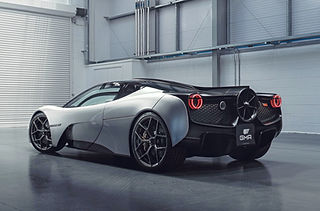
Today, Gordon Murray unveiled his new T.50, a ultra exotic, lightweight supercar with a custom 3.9-liter V12 from Cosworth producing 663 HP with a six-speed manual gearbox and a center seat for the driver. Just 100 will be produced starting at $3.7-million each. Will the investment be as amazing as the F1?

McLaren%20F1_edited.png
T_edited.jpg

1993 McLaren F1

2020 Murray T.50

T_edited.jpg
T_edited.png

For some of us who’ve been around the automotive industry for more than a handful of decades, the term “muscle car” was popularized in the 1960s era of American automakers stuffing big V8 engines into coupes, sedans and a few convertibles. Fast forward to today’s market and, at least for the moment, the only former “Big Three” automaker stuffing snorting V8 engines into passenger cars is Ford. But this hardly means that petrol powered bragging rights are the sole province of the fellas in Dearborn, Michigan.

First a short history lesson. The Dodge brothers built their first car in 1914 and in 1928 their company was acquired by Chrysler. In 1998 the iconic American automaker joined Mercedes-Benz parent to create DaimlerChrysler Motors, an alleged “Merger of Equals”. In 2007 Cerberus Capital Management took control and along with a weak economy, steered the automaker into further distress. After a short restructuring, Fiat acquired a majority stake in Chrysler Corp and in 2014 renamed the automaker to FCA US LLC. Finally in 2021, Fiat and the French PSA Group joined to become Stellantis N.V. with headquarters in Hoofddorp, North Holland.

​

I share this very condensed history to enable readers to grasp how challenging it has been for the Dodge product planners to get really competitive cars to market. Today’s Charger is a great example. After successfully positioning Dodge as a provider of rip-snorting, thunderous performance vehicles, the Netherlands-based Stellantis decided that electricity was the best propulsion system for the Dodge Charger. They might have asked Harley Davidson how sales of their battery-powered motorcycle were doing but wasn’t the car business pivoting to plugs? So 2025 was not a banner year for electric Chargers.

​

This year Chargers are literally roaring back and while not “yet” with HEMI V8 power, the 3.0-liter, twin-turbo, six-cylinder engine offerings are compelling. Charger’s standard offering produces 420 HP with a deep growl out the twin exhaust pipes. Not enough to make your right foot happy? Option the high-output version and 550 HP is on tap, plenty enough to take on most V8s. And early buyers could acquire a Super Bee Launch Edition with 600 HP and that high-octane bee on the fenders. Sadly, they didn’t send me that version.

​

Today’s Dodge fellas position the Daytona as a muscle car rivaling Ford’s Mustang and when applied to the two-door coupe version, that’s fair. But I found this good-looking, well-equipped four-door sports sedan a reasonable rival to a few luxury brands. If you want a GM competitor, it’s Cadillac’s CT5 V, a quite nice sports sedan but you’ll give up 100 HP and some interior space. BMW’s 540i xDrive and the Mercedes-Benz E 450 4MATIC also offer smooth power and handling, but you’ll spend luxury money to sit in those heated seats.


Our Dodge didn’t really rival luxury brands in the elevated detail of materials and precision but our Charger continued to impress me with a long list of attributes that are not often found in high-volume models. And the handling characteristics are quite good for a full-size sedan that adds even more utility with a big rear hatch opening and folding rear seats. The new Charger is a welcome offering in today’s utilitarian marketplace.

Dodge Charger Rear_edited.jpg
Dodge Charger Interior_edited.jpg

THE FINE PRINT

2026 Dodge Charger R/T Plus

TYPE:  Front Engine, all-wheel-drive

ENGINE:  3.0 -liter twin-turbo I-6

HORSEPOWER:  420 @ 5,200 RPM

TORQUE:  469 lb.ft. @ 3,500 RPM

BASE PRICE: $51,995

AS TESTED:  $65,365

FUEL CONSUMPTION:  

17-city, 26-highway, 20-combined

bottom of page