top of page
LAAS_SAB-Line_black_web.png

what's really new from the 2019 show

21_FRD_MCH_48108_edited.jpg

Ford Mustang Mach E

Ford's most ambitious entrance into electrified vehicles yet is not without a bit of controversy. It's not about the all-important range of up to 300-miles, or the spirited acceleration. Even the $45,000 price seems reasonable. But appropriating the Mustang model name, a brand of its own within the Ford oval, has upset more than a few prancing pony fans.

The company asserts that Chairman Bill Ford wasn't keen on the naming strategy until he drove the Mach E, then agreed that it fit the new four-door sports ute. Our view is that the market will decide whether Mustang can be stretched this far, but if Lamborghini and Aston Martin can create SUVs, why not Mustang? But please don't make a Shelby version with skunk stripes and a power bulge in the hood.

Aston Martin DBX

Following in the footsteps of other ultra luxury automakers and market demand, Aston Martin introduced its DBX, a sports utility that delivers the brand's performance and style. The 105-year-old automaker is confident that the DBX will generate new sales from existing sports car clients as well as expand Aston Martin's market. Pricing will hover around $200,000 depending on content, and will compete most directly with Lamborghini's new Urus.

AM DBX
Aston_Martin_DBX05_edited.jpg
Defender rear_edited.jpg
Land Rover Defender

After a 22-year absence, Land Rover's Defender is back on our shores. While some committed off-road enthusiasts might still prefer modifying used Jeep Wranglers for the unpaved, rugged outdoors, the Defender will go anywhere from Hollister Hills to Beverley Hills in style. And while it wasn't shown with an extra spare and shovel attached to the hood like those old Camel Trophy Defenders, there are plenty of helpful options to choose from, including a full roof platform with a ladder access.

Defender
Tesla CyberTruck

It's impossible to be indifferent about the unremittingly rectangular styling of Tesla's new truck concept. Many seem to hate its razor-sharp edgy design, and I'm betting more than a few love the uniqueness. It's not unlike flamboyant architecture that intentionally makes a statement and is both cheered or jeered by a critical public, and that's just what designers live for.

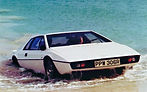
Elon Musk, Tesla's CEO /film buff who borrowed the Ludicrous Speed button from Space Balls, suggested in tweets that he was inspired by the Lotus Esprit in the '70's Bond film The Spy Who Loved Me as well as a flying car from Blade Runner. But a responding Tweet suggested the Jonny Cab from Total Recall could be the source of inspiration.

The market will be the ultimate judge and if Tesla can produce an electric pickup that has 500-mile range along with towing and hauling credentials, the CyberTruck will win its share of buyers.

CyberTruck bed_edited.jpg
lotus_esprit_007_the_spy_who_loved_me_8_
blade runner_edited.jpg
Jonny Cab_edited.jpg
     Bond's Lotus                Blade Runner               Johnny Cab
CyberTruck
ID_edited.jpg
VW ID Space Vizzion Concept

VW's contemporary Space Vizzion (will they really call it that?) is an EV concept that may make production in just a couple of years. Based on the same ID platform with a low, flat battery creating a skateboard architecture, the automaker calls this contemporary people hauler an aerodynamic SUV. Feel free to label it an electric station wagon, the point is that its 85 kW battery allows up to 300-miles of range with the utility that buyers are looking for.

VW ID Space
Lexus LC 500 Convertible

The LC500 looks great as a coupe and just as splendid in convertible trim. While the brand's "spindle" grille doesn't always knock bystanders out in a good way, it seems to give this sporty 2 + 2 the right aggressive luxury. And it's a far better solution for Lexus than the folding hardtop of the SC model that tried to be both a coupe and roadster.

2021_Lexus_LC_500_Convertible_02-1500x85
Lexus LC500 Convertible

For some of us who’ve been around the automotive industry for more than a handful of decades, the term “muscle car” was popularized in the 1960s era of American automakers stuffing big V8 engines into coupes, sedans and a few convertibles. Fast forward to today’s market and, at least for the moment, the only former “Big Three” automaker stuffing snorting V8 engines into passenger cars is Ford. But this hardly means that petrol powered bragging rights are the sole province of the fellas in Dearborn, Michigan.

First a short history lesson. The Dodge brothers built their first car in 1914 and in 1928 their company was acquired by Chrysler. In 1998 the iconic American automaker joined Mercedes-Benz parent to create DaimlerChrysler Motors, an alleged “Merger of Equals”. In 2007 Cerberus Capital Management took control and along with a weak economy, steered the automaker into further distress. After a short restructuring, Fiat acquired a majority stake in Chrysler Corp and in 2014 renamed the automaker to FCA US LLC. Finally in 2021, Fiat and the French PSA Group joined to become Stellantis N.V. with headquarters in Hoofddorp, North Holland.

​

I share this very condensed history to enable readers to grasp how challenging it has been for the Dodge product planners to get really competitive cars to market. Today’s Charger is a great example. After successfully positioning Dodge as a provider of rip-snorting, thunderous performance vehicles, the Netherlands-based Stellantis decided that electricity was the best propulsion system for the Dodge Charger. They might have asked Harley Davidson how sales of their battery-powered motorcycle were doing but wasn’t the car business pivoting to plugs? So 2025 was not a banner year for electric Chargers.

​

This year Chargers are literally roaring back and while not “yet” with HEMI V8 power, the 3.0-liter, twin-turbo, six-cylinder engine offerings are compelling. Charger’s standard offering produces 420 HP with a deep growl out the twin exhaust pipes. Not enough to make your right foot happy? Option the high-output version and 550 HP is on tap, plenty enough to take on most V8s. And early buyers could acquire a Super Bee Launch Edition with 600 HP and that high-octane bee on the fenders. Sadly, they didn’t send me that version.

​

Today’s Dodge fellas position the Daytona as a muscle car rivaling Ford’s Mustang and when applied to the two-door coupe version, that’s fair. But I found this good-looking, well-equipped four-door sports sedan a reasonable rival to a few luxury brands. If you want a GM competitor, it’s Cadillac’s CT5 V, a quite nice sports sedan but you’ll give up 100 HP and some interior space. BMW’s 540i xDrive and the Mercedes-Benz E 450 4MATIC also offer smooth power and handling, but you’ll spend luxury money to sit in those heated seats.


Our Dodge didn’t really rival luxury brands in the elevated detail of materials and precision but our Charger continued to impress me with a long list of attributes that are not often found in high-volume models. And the handling characteristics are quite good for a full-size sedan that adds even more utility with a big rear hatch opening and folding rear seats. The new Charger is a welcome offering in today’s utilitarian marketplace.

Dodge Charger Rear_edited.jpg
Dodge Charger Interior_edited.jpg

THE FINE PRINT

2026 Dodge Charger R/T Plus

TYPE:  Front Engine, all-wheel-drive

ENGINE:  3.0 -liter twin-turbo I-6

HORSEPOWER:  420 @ 5,200 RPM

TORQUE:  469 lb.ft. @ 3,500 RPM

BASE PRICE: $51,995

AS TESTED:  $65,365

FUEL CONSUMPTION:  

17-city, 26-highway, 20-combined

bottom of page